of Paola Mercurelli Salari
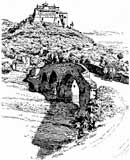
Inside the Benedictine abbey of San Pietro, in a Roman sarcophagus, lie the mortal remains of Saint Vittorino, the unacknowledged co-patron of the town and second bishop of Assisi, who succeeded the martyr Rufino, to whom the cathedral is dedicated. Vittorino too was martyred for his faith and, after being cast onto the flames and emerging alive, he was beheaded with an axe near an ancient bridge on the Tescio that still bears his name. He was buried on the site of his martyrdom, where before long a small church was built to honour his memory. At the end of the 10th century his body was moved to the extra moenia church of San Pietro. In 1642 the Benedictines wished to inspect the sacred mortal remains and give them a more worthy burial. The martyr's bones lay in a small wooden chest next to another one containing bones and linen cloths soaked in blood, a positive proof of the martyrdom suffered by other Christians along with the bishop saint. The event is recounted in a hand-written report preserved in the Frondini Archive and summarised in the Stories of Assisi by Cristofani. In the year 1642 the black monks of San Pietro wished to place the bones of the bishop Saint Vittorino in a more worthy grave, and Malatesta Baglioni, who at that time governed the church of Assisi, ordered a very solemn procession through the entire town. As a result both magistrates and citizens competed in pomp and splendour in decorating the streets and the facades of palazzi and houses with hangings, paintings and flowers. Among these ornaments several triumphal arches were considered to be of great beauty, executed in competition by Marinelli and other craftsmen, as well as two great stories of the martyrdom of the saint, painted by them for the men of Porta San Francesco and for the main square. In the latter, where the magnificence of the apparatus was overwhelming, there were two arches devised with intricate architecture, and a fountain which for that day flowed constantly with wine for the benefit and enjoyment of the people… That procession was also remarkable on account of being accompanied by allegorical figures around the tomb of the saint. Thus, in addition to the four parts of the earth, Italy, Umbria and the town of Assisi were represented there with aristocratic, specially-arranged hairstyles, followed by groups of putti and maidens got up in the style of angels and bearing in their hands the symbols of the principal figures and the instruments of martyrdom of this saint. Marinelli, Martelli and Sermei were entrusted with the invention and execution of all these things.. The loss of the worship of Saint Vittorino, whose feast was celebrated on 22nd August, has inevitably wiped out all other historical memories. It has slipped the town's mind that he shares with San Rufino the burden of having to protect a town known mainly for having been the birthplace of much more illustrious saints. But when the flow of history ends up causing memories to fade, personages and deeds are nourished by their iconographic presence. Two examples are preserved in the Benedictine abbey: a fresco of the mid-14th century attributed to Pace di Bartolo in the chapel of the Sacrament and a triptych (1468) by Matteo da Gualdo, jealously preserved in the convent, where the saint accompanies, with Saint Peter, the Madonna and her Son.