A
LANE LIKE A STADIUM,
of Carlo Cianetti
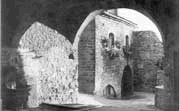
An L-shaped lane, patched, in a few places, with conrete, in others with asphalt. An unwelcoming lane. Its name was hardly an attraction to the tourist. "Obscure Lane." Perhaps it was the only street in Assisi which was scoffed at excessively because of its gloomy name. And yet, it was a part of an intricate and intriguing maze in which certain visitors loved to venture. To put it more clearly, if this infelicitous adjective, on the one hand, discouraged visits, at least on the part of the entirely incurious, on the other hand; it had about it that subtle aura of mystery which are a part of all things which are not very clear, which are, well - obscure. And yet this little lane had too, in its many-centuried existance, en epoch of freshness, enlivened by the rowdy conspiracy of children at play. Even when the voices were hushed, a background sound made it clear to the inhabitants that someone was there, amusing himself: it was the sound of a ball bouncing on the pavement and against the walls. An arhythmic sound, softer when the ball was made of durable plastic, the ones of which it is said, they go like the wind, and which cost 1,000 lire; lighter still, almost ringing, if the ball was a light one of the kind one still finds at the autogrills along the highway; dry and aphonic was the bounce of the leather ball. On school days, the play was restricted by the exigencies of homework; one hour after lunch was permitted, and then the choir of mothers' voices one by one, down the lane, calling the noise soccer players home. Not that the summons were good for much; the game followed its intrinsic and fixed rhythms, established by the small and always identical emotions it afforded. And if the first part of the meeting-up in the afternoon was characterized by the recounting of the morning at school, to the accompaniment of the dull thudding of the ball as it was kicked distractedly up and down the lane, the second part was devoted to disputes about the various competitions made up of kicks or little one- on-one or two-on-two matches. When the number of players was uneven, one resorted to playing "alla Romana": a goalie defended a single goal and other attacked, as before, one-on-one, or two-on-two.The rules were those known in every quarter of the kingdom of soccer. With only one exception, this too well-known: after three corner kicks, which, because of the narrowness of the space were almost impossible to kick, a penalty kick was allowed.The "hit-the-wall," that is the possibility of getting the ball past one's adversary using the side of the wall, was the rule which had been conventionally accepted from time immemorial in the lane. Every day, every match was played with the utmost seriousness. Yes, every match was serious and dogged as is the way with all children's games. But, in addition, everyone knew that there was a great father of the game, a guarantor of its technical level and its supreme judge, to whom one could go in cases of unresolved disputes about the rules, or about the technical correctness of a particular move. Only he was able to say with a precision which was above debate if that tecnical gesture had been an elegant kick "all'ungherese"or merely a vulgar thrust. If that foul should result in a penalty or the punishment of two kicks at the goal mouth. In any case, no one ever had the courage summon him. No one would have been imperinent enough to have distracted him from his difficult and complicated studies or from his exhuastuive arguments with his mother Luigina or with his sister Luciana. Verbal diatribes which they screwed tight in an attempt to present inconfutably, either he to them or they to him, their captious and futile arguments. The women would soon withdraw from the field. Antonio, once he had won, never seemed to be satisfied. The supreme trial, a sort of rhetorical orgasm, consisted in his wanting to corroborate "scientifically" the scant intelligence of the two women. The children, for whom the argument became a sort of background noise which disturbed the bouncing of the ball of their soccer game, knew that this dialectical quarel had been resolved at the moment in which Antonio pronounced the solemn phrase "Ah, who don't you figure out what life's all about, idiots." The upstairs door would slam; the fifteen steps were traversed in five long and dashing leaps. The little door of the building opened up onto the lane, and there was Antonio, as energetic as always. Middle-length wavy hair, slicked down and wet with brillantine and water, black cotton shirt tucked into his belt which was also balck and held up white jeans not long enough to cover his blue kid-skin moccasins, extremely soft and a perfect fit. The sight of the ball excited him. The effect was increased, perhaps, by the umpteenth victory over his mother and sister, and probably by the thought of the games of briscola and tresette which soon would occupy him until it was time to go back to his studies. The young bystanders stopped immediately at the request, both imploring and peremptory "Pass the ball." At that point, everyone scurried off to the side. Only the goalie remained, chance victim of imminent technical vicissitudes. Antonio set off at a zigzaging run during which he shouted out his warning with great delight: "Here comes the bo-o-o-o-o-omb..." What stupified the little boys, and what no one was able to imitate, was the little jump of the virtuoso which permitted Antonio to lift both feet off the ground immediately after having kicked the ball withthe top of his foot. The missile sent out and almost always soared crazily up the stairs and up to the street above. The goalie -- whoever he happened, more's thje pity for him, to be -- merely worried about protecting his face, while the children's eyes followed the ball to see whether or not it would end up under a passing car. The ritual of the bomb was repeated six or seven times. After the which, the blue kid-skin moccasins were dusted off, as well as could be, with the naked palm of the hand and began to skip towards the lower end of the lane, until they began their ascent of the steps which lead to some place far away from the playing grounds. One word of farewell, apparently definitive, and a part of then ritual: "Addio." The little boys were always struck by the agonistic fury of the man. They admired him greatly; he was a source of inspiration; but they were also a little bit afraid. The fact is that the cyclone's passing signalled, too, the end of the afternoon games. Only then were the mothers able to convince the young soccer players to come in and do their homework. The game was resumed later on in the afternoon, around 6:00, and continued until dinner time. With occasional variations: the flicking of bottlecaps on a track drawn with chalk, or hopscotch. The ritual was repeated every day and in every season during the years which spanned the end of the sixties and the beginning of the seventies. One played in the lanes of Assisi; one ran, one shouted, one sweated, fell; the children skinned their knees. Now the Obscure Lane has changed its name. It is dedicated to an emeritus painter. Anemic; it observes the passing bny of the occasional tourist. Its glance is devoid of hope. Antonio has won many competitions thanks, too, to the rhetorical ability developed in his domestic arguments. Today he is a successful judge. But when he runs into someone, he doesn't talk about his work and his professional successes, but of the kicks he made off the top of his foot on that little enchanted stage of the Obscure Lane. In those days, he dreamed of the hundred thousand spectators of San Siro; bad luck has given him instead the audience halls of a law-court.