A
BLOODY WEDNESDAY FOR THE CHURCH OF ST. CLAIRE,
of Francesco Lampone
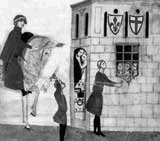
November 28th, 1442 was not just any old day for Assisi. It was a Wednesday, and it had been raining incessantly since the day before. The city was asleep, but a tremendous menace hung over her: Assisi had already been under the siege for a month of more than twenty thousand men, under the command of Niccolo Piccinino, the greatest captain of adventure of the times. Piccinino, born in Perugia, was at that moment at the head of Pope Eugene IV's army; his orders were to seize from the Sforza family their possessions in Umbria and the Marches. Todi's surrender had been obtained; now it was Assisi's turn. Assisi's garrison was under the command of Alessandro Sforza, the brother of Francesco Sforza, the future Lord of Milan. Alessandro himself was destined to the Lordship of Pesaro. But Assisi's rival, Perugia, faithful to the Pontiff, did not want surrender to be a possible solution in Assisi's case; Perugia wanted Assisi to be sacked and destroyed. Dawn is still far off, when a watchman notices suspicious movements in the lands to the North of the Piazza Nuova quarter: the irreparable had occurred; armed soldiers had succeeded in entering the city through the aqueduct, and are exiting, one by one, from its narrow passageway. Alarm is given, but by now it is too late. One of Piccinino's lieutenants, Pazzaglia, is already guiding three hundred men up the slope dominated by the Rocca Minore (Small Fort), towards a small door carved out of the powerful girdle of walls for the comings and goings of the Assisians. From here, the bulk of the besiegers rush forward to attack, shouting " Braccio! Braccio! Piccinino!Piccinino!" forcing those defending the city to retreat into the Rocca Minore. Here they are pursued by Count Carlo Fortebraccio, nephew of the famous Braccio da Montone, who obtained the immediate surrender of no less than eight-hundred Sforza mercenaries, and spared the life of all of them.. An attempt to resist at the extreme border of the Piazza Nuova lanes failed miserably, so much so that Alessandro Sforza, along with his troops and a large number of the city's notables, took refuge in the Rocca Maggiore (Big Fort). Almost contemporaneously, because of the general disorder, the defenses at the lower end of the city also gave way; Piergiovampaolo Orsino managed to make his way forward, break into the Monastery of Saint Francis (contrary to the accords drawn up between Piccinino and the friars), and to capture and take prisoners many of those who had taken refuge there. There is, however, another place, where the Assisian women have sought protection for their children: the Church of St. Claire, behind whose barred gates hundreds of defenseless human beings are crying and praying. Outside, in the mean time, the slaughter of Assisi's last defenders continues. This is the way the story is told in the "Diary of Graziani": "On that day, many and many woman with their little children and with their things and taken refuge in Saint Claire, and still the sack of the city went on; finally the captain came along, the which seeing so many women, along with their offspring hidden there, said to the said women, and especially to the nuns of St. Claire, that this was no longer a good place for them, and that they should choose another place where they should like to go, and that he would send them safely there, and naming one by one all the lands nearby, among which he suggested at last to get them safely to Peroscia, but when these heard Peroscia named, first the sisters, and then the other women answered: --To Perugia! Hmph! Would that the fire would go there! --And so much did he hate this reply that the captain immediately said --Sack! Sack! --; and so every thing was sacked, the monastery with the nuns, the women and their offspring, and there were also a lot of things there." But the sacking continues everywhere, and it is terrible. Houses are despoiled and devastated, and all the comune's archives are burned in the piazza. Women and children are a part of the booty, sold as slaves for fifteen ducats a piece. In some cases, they are purchased by benefactors who then free them; in others, they will be used to perform the tasks of slaves. In the meantime, that powerful rival, Perugia, celebrates the historic victory with fires and the continuous pealing of bells; the rulers of the city go so far as to offer Piccinino a reward of 15,000 florins (a notable sum) in exchange for the total destruction of Assisi; only the churches were to be spared. But the soldier of adventure, who intends to make Assisi a part of his own personal dominion, refuses. Assisi, conquered, devastated, prostrated, has, nonetheless, survived.