|
The
"stranger", who, urged by the enchantment of May, comes to
Assisi, is surprised by the multicoloured flags decorating streets and
squares. In the tangle of narraw streets his attention is captured by
fervour and liveliness: the "partaioli" (supporters of the two
rival sides "Parti"), dressed in red or in blue according to
the colour of their side, adjusting dark and damp basements, setting up
catwalks and stairs, building fountains, see-saws, ovens and strange
devices, rolling barrels and arranging wineskins, restoring windows and
doors, touching up frescos and decorating rooms, recite verses and
miming. What is going on? The stranger receives an unpatient answer
because every minute is precious.
It is the Calendimaggio Festival! People coming from the
"Upper" and "Lower" parts of the town ("Parte
de Sopra" e "Parte de Sotto") celebrate springtime
together. Once they hated each other and fought to the death; today they
compete with enthousiasm in peace and friendship in a bloodless combat.
The stranger nods, eventhough details escape him, he guesses the sense
of an extravagant reality. He would like to visit the places where the
two rival sides gather but he is not allowed to enter because all the
secrets and misteries of the competition are hidden in those places.
Therefore Calendimaggio in Assisi represents a poetic and courteous
transfiguration of the bloody feuds which took place during the Middle
Ages between "Parte de Sopra" and "Parte de Sotto"
.The two warring factions fought violently in a series of perverse
assaults and destruction, ambushes and conspiracies.
The passing of time has purified the bloody streets. Today the same
opposing factions engage in a harmless rivalry using weapons such as
song, music, dance, theatrical art which requires choreographic and
acting skills, contests and scenographic medieval games. Calendimaggio
is a very complex spectacle, recreated each time with fantasy, which
binds bits of history, tales, legend and imagination.
The festival is preceded by preliminary manifestations performed by
artistic and folkloric groups springing from tradition and it is
informally and loudly announced by the "Banditore" (a town
crier).
The highlight of the festival, divided into different phases, is over
too quikcly the physical and intellectual work , the anxieties and
emotions of so many days in a rapid glitter like that of a falling-star.
The historical processions reproposes medieval characters: priors,
judges, squires, halberdiers, knights, lords and ladies, standard-bearer,
pages and damsels, hunters, notaries, spice-sellers, merchants, artisans,
members of confraternities, friars, abbots, ecclesiastic authorities,
magicians, strolling players and minstrels, and finally joyful and
rebellious commoners.
Every procession is announced by the shrill notes of the clarions and
the roll of the drums.
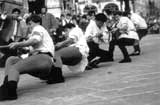
Every procession is greeted by the cry of the spectators who admire the
refined skill of the flag-wavers, the dexterity of the archers and
crossbowmen, who incite their own sides playing medieval games such as
the tug-of-war or the "sled" race or loudly commenting on the
ingenious and some bizarre theatrical surprises.
The two rival sides, in particular the two opposing
"banditori" (town criers) publicly challenge each other in a
verbal duel: rhyme against rhyme, derision against derision, witty
remarks and funny jokes, inflaming the dispute like a fire. What a
difficult task the "banditore" has got.
Among the main characters is the "Maestro de Campo" with his
black costume enriched by an ermine collar: the festival opens with the
cerimonial handing over of the keys of the town to the "Maestro de
Campo" by the Mayor of Assisi, who thus confers on him supreme
authority for the duration of the celebrations.
The language used by the "Maestro de Campo",
"banditori" and different characters, singers and actors, is a
mixture of vulgar and vernacular.
The queen of Calendimaggio is "Madonna Primamera"(My Lady of
Spring), a lovely young damsel who is proclaimed queen by the side which
wins a series of medieval games.
A very modest and graceful girl when compared to the malice and boldness
of the older ladies.
From the hill of the "Rocca" to the crags of Mount Subasio,
the scent of mint, sage and the perfume of broom spread all over the
town mingling with that of the flower garlands which adorne young ladies
hair. The light intensifies the colour of costumes, silk banners,
gonfalons, which are always blessed because the sacred and the profane
must be united.
The banner of the "Parte de Sopra" is blue and represents two
rampant cats supporting a castle, on that of the "Parte de
Sotto", which is red, there is an embattled tower with a flowing
stream.
Scenes of medieval life - real theatrical performances - are re-enacted
in the most picturesque streets of the town. Among hovels,
lodging-houses, markets, bawdy-houses, stores and places of worship in
an urban context partly rebuilt for the occasion; they repropose stories
and tales which sometimes are drawn from history and others are fruits
of popular imagination. In the glare of torchlights the characters play
distinct and opposing roles, animate the narration which usually
concerns everyday life and experiences. They highlight tormented love
and physical endurance which are not always rewarded. However the
complicity of man and nature leads to a happy end. The sound of lutes
favours the intimacy of souls which is exalted by joyful revellers.
This festival, created interpreted and partecipated in by the people,
ends with a choral contest, the final and culminating phase of the
competition. The melody articulates the metamorphosis of the spirit and
senses which follow the alternation of the seasons: from drowsiness to
reawakening. The voices raise to heaven and vanish among sailing clouds
and astonished stars.
The silence is interrupted by impertinent voices and there follows an
anxious wait for the verdict of the judges and the awarding of the
"Palio". It is the "Maestro de Campo" who pronunces
the final verdict, sometimes, without even finishing the ritual formula,
he draws out a blue or red ribbon to assign the victory to one of the
rival sides to the enthusiasm of the winners and the disappointment of
the losers.
The victory consist in the awarding of the "Palio". It is just
a banner but it is more valuable than a gold coffer. What a marvelous
folly!
Chiude
la finestra
|