THE
STORY TOLD BY THE SAN RUFINO FACADE
di Enrico Sciamanna
A
page of stone which hangs over our simple history, and did so even when we
were children and restored it, riding in our every day trousers the pumice
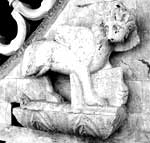
lions, guardians of its portal. Wild beasts who did not frighten us
innocents, as they did the sheep or the farmer with the scythe whose head
they were yanking at. Even the minorites, faded and mutilated on the side
portals, seemed defenseless against them. Perhaps it was because we were
watched over and protected by the beings protrayed on the perpendicular
axis, among which were the faces of our contemporaries solidified ab
aeterno because of their irrefutable merits. Visionary this project, over
a millenium old, of representing a microcosm whcih aspired to
universality; it kept watch over us, observing us with a detached air of
disapproval, quite different from the sexton's, when our soccer balls
slammed (but gently! gently!) against the marble and travertine noses,
tails, foreheads and legs. King David with his psalter had already
foreshadowed, in the hands of mind of Giovanni of Gubbio, the bell-ringer,
a blacksmith or maker of fritters during the week, who rung the bells
double-shift on holidays, with their high cheek bones and cheeks which
revealed generations of enforced abstinence. And the heads of the clerics,
which rested on the lunette's diameter, now the color of blood sausages,
were, in the prophetic prolepses of the wise medieval stone-carver -- the
carpenter, the mason, the tinsmith of our days: with mouths ready for the
liberating curse, sharp eyes for measuring and comparing, any old oval,
whose nobility is expressed by their knowledge of how to go about things,
not by their blood or the harmony of their features, but by their work
ignoble, in those days, as it had not yet been given to man as a means by
which he could transform the world, the continuation of the act of
creation. With a sobbing, leaping syntax, we have here an exposition of
people rather than of events, of faces and meanings rather than of
particularly noteworthy subjects: a wet-nurse laundress is the Madonna of
milk; she is about to remove the child from her breast which has already
assumed the form of a straw-covered wine bottle, later a comfort to him
when he is an adult, so as to put a small cushion on her head and rest
upon it the basket of clothes -- these, too not her own . She will wash
these in the Perlici fountains. Faces with bodies offered up to history,
the history of art as an example and the quotidian history of survival.
Solitary, the dog who wags his tail eternally in a squeal of limestone,
infinite, on the other hand, the wheels of the rose-windows which denote
the obstructed flow of time, grander or less grand, depending on the
merits. Oxymoron, the circle which hints at return, continually echoing
origins. Island in mid- earth (someone will forgive my botched borrowing),
capital of an archipelago, inhabited by giant dwarfs, educated into form
by the commingling of the metal chisel, of dedication, of imagination, and
of stone, with time's, governed by a king whose sadness wells up in every
feature and prompts him to hurry away from the prelate who is drawing near
his throne. Mute collection of history's true or imaginary brief
appearances, walk-ons, two bewildered priests with an immense pyx between
them, and grapes and harvesters, the little cleric with the thurible and
the surplice shaped by the wind, space's guest each day, the *** which
bites the and is in turn bitten, the bust of the ****of many forms which,
with an ever-varying rhythm, appears and reappears with sweet menace in
his face, the heads of oxen, seen formerly in Good Friday processions,
displayed dripping with blood at the nearby butchers', alternating along
the facade with animals which we cannot eaten because we do not know what
they are, a metabolism which is not alimentary, the fruit of chance's
judgement, on which depend too the three telamons of the absolute, three
Atlases of a carved marble universe. Alien, indifferent the vain lionesses
and aristocatic peacocks which face each other at the stone basin's rim;
they tower disdainfully over the bright little figures of the lesser
struts and archtraves, on which their half disc rests. Further above and
at some distance from each other, a wolf and wolfess with teats snarl,
glaring at each other askance; they barelty notice the "cubist"
grackle, orphan of the female bird who has left that corbel empty (who
knows how many spread their wings, as she did, shook out their claws, took
to their legs so as to leave that mineral paradise). And above them all,
the 4 emblems of the 4 evangelists, the whirling merry-go-round's regular
associate.
But above all the stone prevails, with its irregularities and uniformities
of color, the lines that give it shape, whether these are labyrinths or
trailing vines, rectangulars or circles.
And the voices, the shouts which drifted all through Piazza Nova, and made
comunal the goings -on of each household, that shout reflected on the
stones, in the mouthes gashed by the centuries'ice. Angel wings and pigeon
wings, demon wings and the wings of crows.
The story told here belongs to all of us who are able to understand it
because we read it and live it, this text written with a visionary
artist's arbitrary connections; he readied it for us, almost as if
deciding, in this way, that it is this that we would have to become. Lucky
the man who dashed down this page. Who wouldn't quiver with emotion if he
were certain that history would remember a page of what he had left
behind? I personally would be happy with one remembered phrase.