PIAZZA
NOVA - SAN PIETRO: ETHNIC GROUPS FACE - TO - FACE
of Enrico Sciamanna
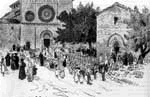
The locals of S. Pietro were afraid of the locals of Piazza Nova. The locals of Piazza Nova were afraid of the locals of S. Pietro. This fear dissolved when they met and their encounters were rarely bloody. In fact I can't remember one of them being bloody, not even when there was some mutual snatching of the neckerchiefs (ours red theirs blue) worn for the May Day Festival - it all ended with much good-naturedness and the restitution of the ill-gotten gains. For someone from Piazza Nova, S. Pietro could not help but be seen from a distant perspective. A comparison was obviously made between the main churches. The very facade of the church looked like a smaller edition of that of S. Rufino: less majestic, smaller lions, a limited variety of building material. It didn't even have a gable and the rose windows were no match: insignificant and all embedded into the wall. A rural churchyard, with grass, which lay on the left to form an embankment. As for the interior, 87% of us had never seen it, but we would undoubtedly have been unfavourably struck by the roughness of the bare stone walls, without those beautiful plasters, frescoes in fact, found in various parts of the presbytery in S. Rufino, which also had a shiny black and white marble floor. Perhaps the steps up to the altar would have impressed us, but that little dome compared to our gigantic copper-green one… The official contact of those belonging to my generation came about as a result of a football match held between students of the secondary school third year: home and away. On that occasion we became aware of their existence as a topographically collocated ethnic entity, and they of ours. The away match took place in the grassy churchyard and, despite their use of extra players and the blessing of the powerful saint, we had a clear win. After the match we walked proudly back up the streets that led us back to our district and spent the rest of the day celebrating, amidst the humiliated silence of the players' relations and in-laws, who had to admit our superiority, loyally manifested, even though it was evident their minds were intent on the rematch, which was fixed in Piazza Nova for the 16th March 1961. It was the day of the total eclipse. A gloomily symbolic day for the youth of S. Pietro: their footballing firmament grew dark, like the sky above the glorious field, which in those days was still occupied by cows, donkeys, ladders, barrels etc., because periodically it was the site of livestock and farm equipment fairs. The latter were removed from the field on the occasion of heroic events such as that which saw as protagonist, under a clear morning sky, but tending to night, the flower of the youth of the upper district. Even the score, which out of charity for my birthplace I would prefer not to mention, fell into evident line with the exceptional nature of the event. Our triumphant ascent was not repeated in those who descended; instead, our families, looking out of the windows onto the streets, their chests puffed out with self-controlled pride, momentarily put down the glasses blackened with smoke by the candles with which they were observing the bizarre sun, to contemplate the humble victims of their athletic offspring. Some, it is fabled, served by solicitous matriarchs, ate chicken that day although it wasn't Sunday, partly to restore their strength and prepare themselves for a further test of their skill. Unfortunately, as far as my generation was concerned there were to be no more encounters, and as a result we needed an excuse to visit that far-off district: seeing friends (we had no difficulty recognising that when all was said and done the aliens were in many respects, if not exactly like us, almost so), or admiration of some girl of other, no rare thing given the abundant local population at the time. Yet it was difficult to establish a relationship, because they, aware of possessing a more refined beauty than we could afford, a beauty made up of vests of the finest cotton, whitewashed kitchens, Deruta tableware and brass beds with freshly-changed bedlinen, rarely conceded visitors more than a smile or a greeting with, at the most, some idle chit chat: "Have you done your homework? I've got an oral exam tomorrow, why don't you polish your shoes?" and sentimental relations were forged for the most part between locals or, at the most, they might include the inhabitants of Piazza, who were more similar to them in character, or, possibly, deserving foreigners. There were few mixed marriages, so the gaps were never bridged. Various scholars have come up with the theory that the difficulty of intercommunication depended on the fact that, whilst we of Piazza Nova were descended from the Umbrians, they were descended from the Benedictines, who already at the time of the founder of the order had colonised the area: the archaeological finds beneath the church tend to confirm such a hypothesis. This might be the reason for the differences, which have become rooted over the years and, although fear is no longer the predominant mutual feeling, the diversity still persists. And it will persist until, with the passing of time, it is absorbed, owing to the demise of the protagonists.