A
SUMPTUOUS SHELTER FOR A "PRECIOUS PLEDGE",
of Pier Maurizio Della Porta
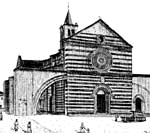
Anyone who looks up at the city of Assisi from the valley will immediately note the monuments which emerge and characterize her panorama and have characterized, too, the iconographic and cartographic representations that have come down to us of Assisi; we refer to the Rocca (Castle), The Tower in the Piazza del Comune, the San Rufino Cathedral and the Basilicas of St. Francis and St. Claire, these last two placed at opposite ends of the street which constitutes the city's principle axis. The Basilica of St. Francis, "caput et mater" of the order, as Gregory IX defined it, had already significantly affected the urban structure of the city when the other "sepulchral" Basilica, that of St. Claire, was built just outside Assisi's walls, near to the church of St. George, just beyond the city portal of the same name. Soon, however, the citizens of Assisi would request that the girdle of walls be enlarged to include the church that conserved the precious relics of the holy mother of the "Damianites." After Claire's death, which occurred on August 11th, 1253, the mortal remains of the saint were buried in the church of St. George. In Tommaso da Celano's Life of St. Claire, the Virgin, we read that this place was chosen because it was felt to be ".. neither a secure nor worthy thing that so precious a token remain so far from the citizens…" and so the body " .. raised high with hymns and praises, with the clangor of trumpets and solemn jubilee …" was transported to the church of St. George, where, the body of St. Francis had also temporarily been laid to rest, before its translation to the Basilica dedicated to him. In reality, the beginnings of the construction of this new Franciscan church (which would become the Basilica of St. Claire) were plagued by more than a few problems, created, above all, by the Canons of the Cathedral Chapter who were the owners of the church and hospital of St. George. The "poor ladies of St. Damian" wanted to move to the place where their mother founder had been buried. An arbiter's decision, handed down by Cardinal Giovanni di Toledo on October 1st, 1253, established that the Bishop of Assisi and the Cathedral Chapter would be given the property of St. Damian and twelve hectares of land; the Chapter was also given 235 pounds in Luccan monies, the rector of the hospital 815 pounds, so that he could rebuild the hospital somewhere else; the nuns, in exchange, were given the church and hospital of St. George and a piece of land nearby. In fact, the dispute continued with various vicissitudes for several years, until Alessandro IV definitively resolved the question with a "mandate" in which he threatened to throw the canons out of San Rufino and excommunicate them, if they continued to obstruct the execution of what had been decreed in his and earlier papal letters, impeding the "co-sisters" of St. Claire to settle in the place where their mother and founder was buried. In any case, despite the property question, some "nuns" had already moved into the new seat, probably as early as 1253; a small community of brothers had also settled there, their task being the celebration of the daily liturgical services. It was, almost certainly, in 1257 that work on construction of the new church began, and in 1260, the body of St. Claire was translated there. In September, 1265, with great solemnity, the Basilica was consecrated by Cardinal Rodulphus de Chevriere, while Pope Clement IV himself consecrated the high altar, conferring important privileges upon the church and her visitors. The work was completed in the 14th century. The Basilica grew to resemble its "older sister," the Basilica of St. Francis, imitating its forms and structures, but differentiating itself by means of original architectural characteristics and solutions. The Basilica of St. Claire and her annexed structures, along with the Basilica and Convent of St. Francis, represent, also concretely, a particular relation between the Franciscans and the city of Assisi; the curial dispositions are themselves a historical witness to this particular rapport. In 1265, for example, it was decreed that no church building could be constructed within 300 rods (about 600 meters) of either Basilica. Nicholas IV, in 1288, went so far as toprohibit the founding, on the part of anyone, either belonging (or not) to any of the mendicant orders, of churches, oratories, convents, or monasteries, either in the city of Assisi or her suburbs, as well as in the countryside within 200 rods of the city or suburb walls. The preponderance of Franciscans in the small urban space of the city is demonstrated, not only by the dimensions of the two monuments, out of proportion, given the size of the city's structures themselves, but also by the fact that these Basilicas have become emblems of the Franciscan Orders, with a significance which goes way beyond the reality of the small city of Assisi, defining her to such a degree that she becomes, in fact, the image itself of the "Franciscan City."