A
LENT AT THE LAKE,
of Giuseppe Bambini
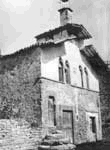
The Little Flowers of St. Francis narrate (chapter VII) that St. Francis went, with great secrecy, to Isola Maggiore (Greater Island) in Lake Trasimene on February 16th, 1211, -- Ash Wednesday -- and fasted there for an entire Lent "on just half a loaf of bread." He was accompanied there by a boatman who was a friend of his, whose guest he was, and whom he begged not to reveal to anyone the place where he went to pray. He sojourned in the midst of a thicket which was very thick and narrow; plum trees and bushes had reduced it to a sort of hut, or better, burrow. In those days, the island was uninhabited and when, on the 30th of March, Holy Thursday, after 42 days, his friend returned to fetch him, he found Francis in good health; of the two loaves of bread he had given to his friend he found one and a half, " and so with that half loaf of bread he had driven away the poison of Vainglory." "Since Francis's abstinence on that island had been so marvelous, men began to build houses there and to live in them, and in a short while a good and great castle was made there; and it was the place of the friars, and was called the place of the Island. And the men and women of that castle still revere and have a great devotion to that place where St. Francis spent the said Lent." The proposed itinerary, easy and accessible to everyone, permits one to get to know this picturesque island. We recommend comfortable clothes and shoes suitable for a day in the country. Tourist Map Kompass N. 662 "Lake Trasimene" scale 1:50000, compass, binoculars to enjoy the panoramas and a camera for anyone who wishes to remember. But why travel by car, when numerous trains leave Assisi's Train Station (inf. Tel 075-8040270) and permit you to reach Passignano sul Trasimeno comfortably in just 50 minutes? Itinerary: from the Passignano Train Station (263m) begin to walk to the right and, once past the railroad tracks, continue along the tree-lined sidewalk which borders the lake and will bring you in no time to the Passignano Dock (15 min. from the station) where you can get the ferry (inf. tel. 075-827157) which will bring you, in 30 minutes, to Isola Maggiore. Lake Trasimene takes its name from the legendary Trasimeno, son of king Tirreno who, seduced and abandoned by the beautiful and fatal Agilla, met his death in the lake of his own tears. It extends for a area of 128 square kilometers, its maximum depth is 6 meters, and it has a perimeter of 45 kilometers. Its waters are populated by pike, carp and eel./ The uniformity of this sheet of lake water is interrupted by three islands: La Maggiore The Greater, (23 hectares), La Minore, The Lesser (6.4 hectares) and Polvese (64 hectares)/. During autumn and winter it sometimes happens that the lake becomes suddenly stormy; rarely does it freeze; if froze completely for the last time in 1985. From the Isola Maggiore Dock (260m), just after a small piazza shaded by majestic live oaks, you will find yourself in the principle street of the characteristic village -- Via Guglielmi - paved with bricks and overlooked by the fishermen's typical homes. Continue on to the right; where the houses end, a small road, ascending slightly, will take you to a fork. Continuing on straight ahead -- among pines, live oaks, cypresses and oleanders -- you will come to the entrance of the Guglielmi Castle or Villa Isabella. Built by the Marquis - and senator - Giancinto Guglielmi and his wife Isabella at the end of the 19th century on the remains of a Franciscan convent (built in 1328, enlarged in 1480). Among its most illustrious guests should be remembered Corrado da Offida, Saint Bernard of Siena (1444), Pope Pius II (1459) and Pope Julius II (1511). Hugging the walls of the castle, descend to the right and you will reach a grassy plain where a small circular edifice stands -- called the Island Mill -- where it is well worth your while to pause and enjoy, at your ease, the harmony of the lake view. Go back to the castle entrance and then to the fork. Now go right on a small uphill road through thick olive groves which will bring you to the island's highest point (309 m) where you will find the Church of St. Michele Archangel (12th century, restored in 1933) . To visit the church (which we recommend) you must inquire at the Pro-Loco (inf. tel. 075-8254222). The interior, with its single nave, is enriched by frescoes dateable to between the 14th and 15th centuries. There is a grand panorama of the island here, and of the gentle green hills which face the banks and mountains of nearby Tuscany. It will be easy to identify the four promontories which jut out into the lake: Punta Navaccia (N-W), Passignano (N-E), Monte del Lago (S-E) and Castiglion del Lago (S-W). Continue along down the "street of Saint Salvador," flanking the cemetery surrounded by high cypresses. At the first fork, go right on the grassy descending path; at the second fork, do not take the ascending road to your right but the one immediately after it with the wooden handrail (also to your right). You will come to the St. Francis Chapel which commemorates the hut which once stood here; inside is kept the hard stone which served the Saint as a bed during the Lent of 1211. Continuing along your descent you will come to the Chapel of the Landing, with the St. Francis Fountain inside it. Directly in front of the Chapel, note the "St. Francis Reef" where -- according to the legend - the Saint came ashore on February 16th, 1211, leaving his footprints as he did so. Look for these, it will not be difficult to find them! Continue along to your left on the little street which keeps to the lake shore -- afforded shade by the Mediterranean woods -- with splendid views of the woody Isola Minore, privately owned, and uninhabited for some time now. You will come to a little beach, then a short flight of stairs on your left will take you to the Church of Saint Salvador (12th century). On the facade, high up on the right, is a sculpted head of Frederick Barbarossa (Redbeard). Inside, a "Madonna and Child with Four Angels" (15th century) by Sano di Pietro and a wooden panel painting of the "Annunciation." (1425). Going back down the steps, continue on the left, returning, once again, to the village's principle street, Via Guglielmi, along which you will encounter: - the parish Church of Good Jesus (15th century, amplified in the 17th century) with two interesting canvases in its interior - the House of the Captain of the People or of the antique clock (14th century) with bifore windows, jutting eaves and a characteristic stairway. - a building of the13th century, recently restored; to be noted here on the portal is a crest carved into the stone: the narrow lower sword makes the cross seem like that used by the Templars. At this point, you can consider your visit to the island to have concluded (1 hour 20 min. for the entire walk), but before getting back on the ferry, treat yourselves to a stop and perhaps a sandwich made with excellent prosciuto at the bar-market Fanfani, just two steps away from the dock. Get the kind Signora Fernanda and her daughter Silvia -- who have lived here always -- to tell you the stories of this picturesque burg of fishermen and, above all, the story about the "Irish lace," introduced to the Island by the Marquess Isabella, a most idiosyncratic tradition which lives on today among the burg's women.