JOHN
PAUL II AT THE CATEDRAL
of Francesco Frascarelli
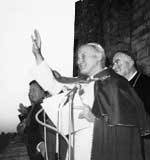
Assisi beloved by John Paul: five pilgrimages and, one never knows ....His hands opened the doors of our city and a huge mass of people flowed in from lands near and far to listen to his words. The essential reason for this preference for Assisi lies in his acknowledgement of the indissolvable link between these ancient stones and Francis. In the context of history's contingencies, Assisi has remained a small city-castle on a hill, but she has acquired the valency of a transcendental symbol and many charming epithets. She is part of an earthly and divine sacredness, destination of the faithful and devout, poets, writers and artists, ascetics and travelers, sovreigns, dignitaries, political personalities, popes ... On two occasions, John Paul has crossed the threshold of the San Rufino Cathedral. Friday, March 12th, 1989. The church's interior has, by now, been arranged in accordance with the recommendations of Vatican stafff members given during the course of several inspections. The staff on duty, given the imminent and yearned-for arrival, sees to the changing of the microphones and forbids any to and fro in the area of the presbytery. He arrives in the early afternoon by car from the Basilica of St. Francis, where he has participated in a special Assembly of Italian Bishops, called to celebrate the 8th centennary of the birth of the saint who imitated Christ both faithfully and ardently. The pealing of bells and applause is replied to with gestures of affection. The pontiff, giving his blessing, walks up the central nave, next to Bishop mons. Sergio Goretti who introduces him to the Chapter Prior don Aldo Brunacci and the rector, don Orlando Gori, of whom the Holy Father asks an embarassing question; Where in this church is the Sacrament? The replied is given punctually, but with some timidity: Holiness,we have a chapel for it! John Paul II takes his place on the faldstool before the high altar. Bishop Goretti sketches for him, briefly, the parish's physiognomy: the clerics are few, but there are young priests who work with generosity and enthusiasm; the oldest continue to work with admirable zeal and dedication; lay participation increases every day. The pontiff responds to the bishop and to the crowd of listeners -- composed of priests, religious, and the representatives of diocesian lay movements -- and develops certain themes: bringing Christ back into society; leaving the sacristies behind and going out into the ways of the world; working united by charity; eight centuries after his birth, even those who are remote from religious values still look to Saint Francis in admiration, for they see in him an authentic copy of Jesus Christ. At the end of the encounter, the priests come up to kiss the ring. The pontiff dispenses gestures of cordiality and makes his way to the exit. Outside, groups of young people greet him with enthusiasm. John Paul II, after paying homage to the nuns at the Basilica of St. Clair, concludes his visit with an address to the people of Assisi, delivered in Saint Mary of the Angels, in the square in front of the Basilica there. Monday, October 27th, 1986, a day of prayers for peace, announced on January 25th in the Basilica of St. Paul: "The Holy See wishes to contribute to the creation of a world movement of prayer for peace ..." Assisi gives a worthy welcome to the representatives of the religions, thanks to the convictions of her community, rendered sensitive by her many lay and ecclesiastical associations. Careful and complicated were the preparations to ensure that all guests received all the same attentions. With respect both for spiritual factors and the exigencies of ritual, places were chosen which would be appropriate for prayer and meditation for every single religion. To the heads of Churches, Confessions, and Christian communities, the Cathedral of San Rufino was assigned. Monsignores and Vatican functionaires visited the church complex and its annexes several times to ensure that everything was done with the greatest care: an adequate logistical organisation, a choreography simple but effective. Certain irreversable decisions were made: access to the church would be strictly supervised, routes well-defined, the pontiff would stand in the center of the presbytery, but on the same level as all the others; the elimination of rugs, the use of wall-to-wall carpeting, yellow-cream colored; temporary accomodations would be set up for a brief pause after the ceremony. October 27th, half-way through the morning. The pontiff and the delegations of Christian Confessions (Anglicans, Catholics, Orthodox, Protestants, and related branches) come to the Cathedral from Saint Mary of the Angels, where the first meeting of the leaders of all the religious confessions had occurred, just in front of the Porziuncola. The faces, expressions, gestures, and fashions all give rise to curiosity and comments -- as do the women bishops and priests. The "anchor man" for this live transmission, organized by a pool of Umbria television stations, and hooked up with other places and prayer groups, is the diocesian vicar Monsignore Vittorio Peri, responsible for the day's general organisation. The pontiff in his white overcoat, the orthodox patriarch Methodosios with his dark cloak, and the Anglican primate Robert Runcie, wrapped in an amarant-colored vestment, are conducted to the Chapel of the Sacrament where they genuflect: only the aforementioned do so, as their confessions alone recognize the presence of Christ in the Eucharist. After the adoration, they stand and go towards the high altar around which the others are taking their places. The minute figure of Mother Teresa of Calcutta stands out in the audience. John Paul greets the assembly with a passage from the letter to the Jews. He goes on to speaks in tones of encouragement and admonition: commitment to overcoming the serious divisions which still exist among Christians; regret at the lack of attempts to carry forward the mission of peace and reconciliation; awareness of the exigencies of justice, inseparable from the peace process. The pontiff offers up a prayer to the Father. A song marks the beginning of the Proclamation of the Word, interspersed with readings, psalms, and hymns in which the Christian delegations directly participate. The execution of the Hallelujah and the Veni Creator start off the series of Intercessions or, rather, the invocations of God, internalized through moments of silence, pronounced alternatively in different languages. With what decisiveness, what compelling rhythm do these exaltations ring out: of truth, of justic, of liberty, of rights, of reconciliation, tollerance, respect for the environment; how peremptory and determined the condemnation of war, of violence, of torture, of the arms race, of hunger, racism, egoism, arrogance, of exploitation, avidity, prejudice, and of oppression.The exchange of wishes for peace, the Our Father, and a song conclude the celebrations. The asasembly is dissolved. The staff of the day accompany the pontiff to a small door in the right nave: as they walk down the corridor, the rector gives historical explanations. There is no trace of tiredness on the pontiff's face; his figure is a bit bent, but very much present. Nonetheless, this, one notes: he drags his feet along the pavement. The sacristy door opens and closes. The pope is spirited off and conducted to a room almost entirely inaccessible, protected by a room commonly called "the big chimney place." The parish priest and the house staff serve tea and coffee to the delegations dispersed throughout the house and the museum. Hand shakes, collquies, observations. But now the pause comes to an end. The procession reforms in the church. The pontiff and the the orthodox patriarch return to the Chapel of the Sacrament for the adoration. The Anglican primate is missing. He is looked for -- no trace anywhere -- worry, every corner is searched. He seems to have disappeared. Consternation. Inspections everywhere. The rector goes back into the house and looks in every room, even the most improbable ones. And it is, in fact, in the office of the vice-rector, don Luciano Avenati, that the primate is found, absorbed and impassive. Courteous attentions are given. The exit from the cathedral is orderly. Acclamations and homages. The pontiff gives no blessings; he advances with bowed head; this keeps him from being the event's protagonist; there is to be no Catholic primacy. He maintains this posture all the way to the Basilica of Saint Francis. In the lower square, under a grey sky, the great project to gather together the representatives of all religions draws to a close. The pontiff had said, inititially, in front of the Porziuncola, that there is "another dimension to peace, and another way of promoting it, which is not the result of negotiations, of political compromises, and of economic accords. It is, instead, the result of prayer." Question: What is the role of prayer in the peace process? A passage from the speech given in the cathedral can be taken as an answer: Peace is a gift from God and therefore prayer becomes essential. But if peace is a gift of God, should man simply pray and wait? The implied reply: Peace is a gift of god and we must ask Him for peace through prayer, but peace is also "creation" by man by means of the various instruments which the converted conscience suggests. "Help so that God may help you": the proverb assumes the valency of a theological orientation: peace as a projection of the divine plan but at the same time as a creation of man. In just this way, we can explain the invitation contained in the thirteenth Intercession "...let us pray for the politicians to whom the peace negotiations are entrusted; may they learn to have faith in each other and may the accords they reach be respected."Several years have passed since that October 27th. History has, since then, seen many changes and upheavals. Crucified humanity remains. A seed was planted then. With respect to the times to come, an ineffable fraction of time has passed. Shoots have sprouted, but peace's flower delays and does not bud. The Jubilee could encourage the will to pray and foster useful enterprises.When will the time of the Great Alliance come.