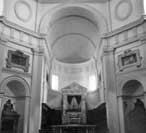
of Pier Maurizio Della Porta
Codexes particularly valuable, both for their decoration and content, testify to a high level of liturgical musical activity at the Cathedral; there are particularly important codexes from the 13th and 14th centuries, one of which, number 5 (13th century) conserves two documents of archaic polyphony: Virgo solamen desolatorum and a Gloria patri, both for two voices. It seems reasonable to think that the presence of the Basilica of St. Francis, an extremely lively cultural center, as the epoch's documents bear witness, also as far as music is concerned, must have influenced musical practices in the city of Assisi, both during the 13th and 14th centuries and afterwards. Documents conserved in the Capitular Archives refer to the existence of an organ as early as the 15th century and. from that century on, we have recorded, in the administrative registers of the San Rufino Archives, the hiring of organists to "adorn" the holy offices and the liturgy. Between the end of the 15th century and the beginning of the 16th, the bishops requested the intervention of singers from nearby localities for the celebration of the most important festivities. For example, payments are documented for the dinners of the "singers of Peroscia," who came to sing on August 11th, 1504 for the feast day of San Rufino; various payments are also recorded for subsequent years, above all in connection with San Rufino's feast day and Christmas. Angelo Marzi from San Gimignano was bishop of the city of Assisi from 1528 to 1541, and under his bishopry musical activities at the cathedral intensified. Indeed, with his connections to the Medici Court, Marzi was an authentic patron of music: he is remembered, too, by Vasari for having been summoned to Florence on December 5th, 1535, upon the occasion of the 'Basso Fortress's" inauguration, to officiate over a solemn mass, an occasion on which magnificent music was played. Bishop Angelo Marzi must have encouraged the use of "figurative song" in the cathedral of Assisi; the canons, for example, had to cover the costs of "meat for those who sang the mass in figured song on Christmas night" in 1508; however other entries for the payment of additional singers, not part of the standard San Rufino Chapel, who were summoned to sing in "figurative song" on particularly solemn occasions are also recorded in the Capitular 's administrative registers after the bishopry of this remarkable figure. In 1508, the cathedral's canons requested an organ more in keeping with the "new" liturgical music. We know about this organ 's technical characteristics and that it was constructed by Giannino da Volterra; we know, too, that there was a great controversy over its quality which involved both the canons and its constructor, resolved only in 1512 when a commission of experts established that the the organ's construction was state-of-the-art. Father Albino Varotti claims that the constitution of a proper musical choir can be dated back to 1525; singers, organists and choir masters are all important to its going forward; their compensations are diligently noted down in the administrative registers of the Capitular Archives. Among their names, we find those, too, of foreigners, for example, Giovanni Tollio (1570), originally from Amesfoort in Holland; accused of heresy, he was defended by Assisi's bishop, Giuseppe Brugnatelli; he has left us valuable polyphonic compositions. We find, too, the Frenchmen Claudio Neviros (1588) and Camillo Matlem (1592). Some choir masters taught music at the diocesan seminary, instituted in 1574; the addition of voices from the seminary school no doubt brought about an enrichment of the choir. In the 17th century, we find the names of great musicians present in Assisi for the sake of San Rufino's musical Choir: Don Egidio Jarram (1617-1620) choir master and composer who went on from Assisi to direct France's Royal Choir; Giovanni Bovicelli, the celebrated theoretician and composer, sang at the Cathedral from 1622 to 1627 and during this same period the Francesco Fracassa was choir master; other names which particularly stand out are that of the famous Giacomo Carissimi (1628-1630), as well as Giuseppe Ottavio Pitoni, another important musician and performer who was at the Cathedral between 1674 and 1676. In the 18th century, the names of Pietro Benedetti and Pietro Serafini also stand out. In the 19th century, the choir was directed for many years by Francesco Sabatini and benefited from the collaboration, on occasions of particular solemnity, of musicians and choir masters from the Basilica of St. Francis. The musical choir of San Rufino continues its liturgical activities today. Formerly directed by Don Mario Pierluca, it has been directed now for many years, with passion and dedication, by Don Giuseppe Biselli. A valuable organ which goes back to the 17th century and which has been restored many times, and probably modified, can still be found in the Sacrament Chapel. Just before the earthquake, the high organ had been restored and placed in a position slightly different from its original one. This is an extremely valuable instrument built between 1848 and 1851 by the Martinelli brothers from Umbertide. Prior to this one, another instrument had been constructed for the Cathedral by the organ builder Andrea da Firenze in 1516; this organ, larger than the one made by Giovanni da Volterra in 1508, restored and retouched in various periods, remained in use until the 19th century. The Brothers Martinelli organ, which cost, at the time, 741.80 Roman scudos, is an extremely valuable instrument with two chromatic keyboards with 54 keys and a pedal keyboard of 17 notes, the first octave of which is "short," the other keys are for drums, etc. What we have here really are two organs contained in a single case; it consists of 1169 pipes, of which 25 Principal pipes are on display. The music box, removed perhaps in 1905, has been reconstructed. The organ had been dismantled and for many long years, the materials were "stockaded" at the seat of the Santo Stefano Confraternity. Now, thanks to the wishes of the Bishop and the assiduous work of the architect, Giulio de Giovanni, who oversaw the rehabilitation of the instrument from the structural point of view, the organ has undergone a masterly restoration and reassembling at the hands of Marco Valentini, a meticulous master organ constructor of our times, who began his work with a scrupulous historical-documentary research. Thanks to the confluence of these wishes and skills, the high organ of San Rufino was "inaugurated" once again with an exceptional concert given on August 11th, 1997 by the maestro Luigi Coleghin (For anyone wishing to know more: Albino Varotti, The Musical Choir of San Rufino in Assisi: a contribution to its history in "Bulletin for the Deposition of the History of Umbria," 1967; Marco Valentini, The High Organ of San Rufino in Assisi, Description and Restoration, "Notebooks of the Propertian Academy of Mount Subasio," Assisi 1998; Gailiano Ciliberti, Music and Society in Umbria from Medieval to Renaissance, Brepos, Brescia 1998).